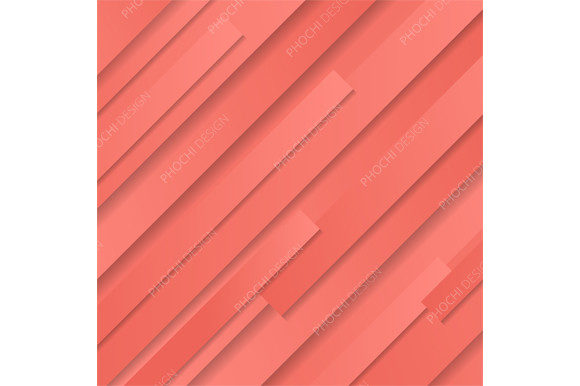
Abstract Striped Geometric Pattern: A Versatile Vector Foundation for Design Excellence
Designers, educators, marketers, and product teams increasingly rely on high-fidelity, adaptable assets—not just for visual polish, but for functional precision. Among the most widely adopted foundational elements in contemporary digital and print workflows is the Abstract Striped Geometric Pattern. Far more than a decorative motif, this vector-based composition merges mathematical rhythm with expressive color theory—particularly when rendered in the warm, energetic tonality of coral-infused pink, arranged in oblique, dynamic alignments. Its strength lies not in novelty alone, but in its structural integrity, scalability, and contextual flexibility across disciplines.
What Makes This Pattern Structurally Distinct?
Unlike raster-based textures or algorithmically generated noise, an Abstract Striped Geometric Pattern built as 100% vector artwork adheres to precise geometric logic. Stripes are not approximations—they’re mathematically defined paths with consistent stroke weights, angular fidelity (typically 15°, 30°, or 45° obliques), and deliberate spacing ratios. The “geometric” descriptor signals intentionality: angles intersect cleanly, parallelism is preserved at any scale, and modular repetition supports seamless tiling without distortion. When paired with coral color pink—a hue balancing warmth (red undertones) and vibrancy (pink luminosity)—the pattern gains psychological resonance: it feels approachable yet confident, modern yet grounded.
This isn’t arbitrary aesthetic selection. Coral’s chromatic properties—its medium saturation and light reflectance—ensure legibility when overlaid with text or icons. Unlike neon pinks that fatigue the eye or desaturated mauves that recede too far, coral maintains presence without overwhelming. In practice, this means designers can use the Abstract Striped Geometric Pattern as both background and compositional anchor—placing white typography directly over it without drop shadows or opacity adjustments.
Why Vector Fidelity Matters Across Real-World Workflows
The specification “all graphics are 100 vector” isn’t marketing language—it’s operational necessity. Consider three distinct professional scenarios:
- Brand Identity Systems: A university communications team developing a new campaign for STEM outreach uses the Abstract Striped Geometric Pattern as a unifying visual thread. They apply it to presentation templates, social banners, and printed posters—all at varying dimensions. Because the file is vector-native (EPS), resizing from a mobile ad (1080×1350 px) to a 6-foot-wide exhibition banner introduces zero pixelation, no re-rasterization, and no loss of crisp edge definition.
- Educational Resource Creation: An instructional designer building an open-access physics module embeds the pattern into interactive PDFs. Since editable text and shapes remain fully manipulable in Adobe Illustrator or Affinity Designer, they replace placeholder labels (“Force”, “Velocity”) with subject-specific terms in their institution’s typeface—without breaking alignment or altering stripe geometry.
- Product Packaging Prototyping: A small-batch cosmetics brand tests label variations using mockups. With the coral-striped vector file, they shift hue values non-destructively (e.g., desaturating by 10% for a matte black bottle, boosting brightness for a frosted glass variant) while preserving exact stripe width and angle—ensuring color studies remain geometrically consistent.
In each case, the absence of raster dependencies eliminates version sprawl. There’s no need to maintain separate JPGs for web, PNGs for transparency, or TIFFs for print—the single EPS source serves all outputs. And because the file includes editable color swatches, swapping coral for indigo or charcoal requires two clicks—not hours of manual path adjustment.
Practical Implementation: Beyond Backgrounds
While often deployed as a full-bleed background, the Abstract Striped Geometric Pattern shines in nuanced applications where hierarchy and function intersect:
Guiding Visual Flow
Oblique stripes inherently suggest directionality. Designers place them diagonally behind data visualization elements—like bar charts or timeline infographics—to subtly reinforce progression from bottom-left to top-right. This reinforces natural reading patterns in left-to-right languages without competing with content.
Creating Zoned Layouts
Rather than covering an entire canvas, segments of the pattern can define functional zones. For example: a coral-striped band at the top 15% of a workshop handout signals “key takeaways”; a narrower horizontal stripe beneath a headline separates navigation from body copy; or a rotated block behind a testimonial quote adds emphasis without ornamental clutter.
Enhancing Print Tactility
At 300dpi resolution, the vector-to-raster conversion preserves micro-detail critical for premium print. When combined with spot UV coating or subtle embossing on business cards or report covers, the geometric precision translates physically—stripes retain sharp edges, and the coral ink renders with consistent chroma across paper stocks (uncoated, silk, or metallic).
User-Centric Considerations: Accessibility and Adaptability
Responsible design demands attention to perception diversity. The coral color pink striped geometric oblique background meets WCAG 2.1 contrast guidelines when used with appropriate foreground elements: black or dark charcoal text achieves a contrast ratio above 4.5:1 against the base tone. However, designers should avoid pairing it with low-saturation pastels (e.g., mint green or butter yellow), which risk insufficient differentiation.
Equally important is cognitive load. While geometric repetition aids pattern recognition, excessive density can distract. The included “copy space” in the file isn’t merely empty margin—it’s intentional negative space calibrated to support readability. Users can confidently overlay paragraphs, bullet lists, or callout boxes without obscuring meaning or forcing awkward line breaks.
For educators and researchers, this predictability matters. A lecture slide using the Abstract Striped Geometric Pattern won’t require last-minute font-size adjustments to ensure legibility in a large auditorium. For hobbyists learning vector tools, the organized layer structure—grouped by stripe angle, color group, and text placeholders—serves as an implicit tutorial in asset management best practices.
Integration Across Platforms and Tools
The dual-format delivery (EPS + JPG) bridges compatibility gaps without compromising quality:
- EPS files retain full editability in Adobe Creative Suite, CorelDRAW, and Inkscape. Designers can isolate individual stripe groups, adjust global color themes via swatch libraries, or convert paths to live paint objects for gradient experimentation.
- JPG exports provide immediate usability in platforms with limited vector support—such as Canva, Microsoft PowerPoint, or learning management systems like Moodle or Canvas. At 300dpi, these files scale cleanly up to A3 size for classroom posters or conference signage.
No watermark means no friction in client deliverables or collaborative reviews. Business owners deploying the pattern across Shopify banners, email headers, and investor pitch decks avoid legal ambiguity or last-minute cropping to hide branding artifacts.
Emerging Applications: From Immersive Interfaces to Physical Spaces
As design thinking expands beyond screens, the Abstract Striped Geometric Pattern demonstrates surprising adaptability:
In spatial design, architects project scaled versions onto façade mockups to study how rhythmic patterning affects perceived building height or material rhythm. Interior stylists use the coral-striped vector as a base for textile prints—scaling stripe width to match upholstery weave densities or tile grout lines.
In motion design, animators import the EPS into After Effects via Adobe Bridge, then animate stroke offset or rotation parameters to create parallax-like depth—giving static backgrounds subtle kinetic energy ideal for explainer videos or app onboarding sequences.
Even in data sonification projects, researchers map stripe density to variable thresholds (e.g., higher infection rates = tighter stripe intervals), transforming abstract metrics into intuitive visual rhythms—making the Abstract Striped Geometric Pattern not just decorative, but interpretive.
Choosing Thoughtfully, Not Just Stylistically
Selecting this pattern shouldn’t be about trend alignment alone. Its value emerges when matched to purpose: Does your project demand scalability across unpredictable output sizes? Do collaborators need to modify color or text without design expertise? Is tactile consistency across physical and digital touchpoints essential?
If yes, then the technical attributes—vector purity, oblique geometry, coral’s perceptual balance, and layered organization—aren’t features. They’re prerequisites. And because the file arrives with no licensing restrictions beyond standard commercial use, integration becomes a matter of workflow efficiency, not rights negotiation.
Ultimately, the Abstract Striped Geometric Pattern endures not because it’s visually arresting (though it is), but because it solves recurring problems: inconsistency, fragility under scaling, inaccessible color contrast, and toolchain fragmentation. It’s infrastructure disguised as aesthetics—quietly enabling clarity, cohesion, and confidence across every discipline that relies on visual communication.