Single Ceramic Dinner Plate Mockup
If you’ve ever spent hours designing a custom ceramic plate pattern—only to struggle showing it off in a way that feels authentic and polished—you’ll appreciate how much time and confidence the Single Ceramic Dinner Plate Mockup saves. This isn’t just another static image overlay. It’s a thoughtfully built, production-ready resource designed for creators who need realism without complexity.
Imagine launching a new tableware line on Instagram and needing to showcase your hand-painted botanical motif—not as a flat JPEG, but resting naturally on a clean, softly lit ceramic plate with realistic shadows, subtle texture, and accurate curvature. Or picture preparing a pitch deck for a boutique kitchenware brand and wanting to demonstrate how your minimalist monogram looks across actual dinnerware—not sketches or wireframes. That’s where this mockup delivers real value: it bridges the gap between concept and credibility.
Who Uses This—and Why It Fits Their Workflow
Freelance surface designers often juggle tight deadlines and client revisions. With the Single Ceramic Dinner Plate Mockup, they drop their pattern into a smart object layer, adjust color tone if needed, and export a photorealistic preview in under two minutes—no retouching, no lighting guesswork. The organized, color-coded layers mean even someone who opens Photoshop once a month can navigate it without digging through folders or watching tutorials.
Small business owners launching ceramic tableware on Etsy or Shopify use this mockup to build cohesive product listings. Instead of hiring a photographer for every variation (gold rim vs. matte black vs. sage green), they tweak colors directly in the PSD and generate consistent, high-resolution visuals. One user told us she cut her listing prep time by 70%—and saw a measurable lift in click-throughs because her images looked more intentional and tactile.
Educators teaching digital design or product visualization use this mockup in classroom exercises. Students learn about layer management, resolution standards (300dpi), and smart object workflows—all within a familiar, low-stakes context. Since the base artboard is 6000 × 4000 pixels, students can zoom in without pixelation, study shadow gradients, and understand how light interacts with curved ceramic surfaces.
Real Situations Where It Makes a Difference
You’re finalizing a wedding stationery suite and want to extend the floral motif onto custom dinner plates for the reception. Instead of waiting for physical proofs—or worse, guessing how the pattern wraps around the rim—you insert your vector artwork into the mockup, rotate it slightly to match plate curvature, and instantly see how spacing and scale hold up.
A food blogger partners with a local ceramics studio to co-create limited-edition plates. They need social media assets fast—no studio shoot scheduled yet. Using the Single Ceramic Dinner Plate Mockup, they mock up three versions (one with their logo, one with a seasonal quote, one blank for styling shots) and post them as “coming soon” teasers. Engagement spikes because followers respond to something that feels tangible—not abstract or placeholder-like.
A packaging designer working on a sustainable tableware rebrand needs to present options to stakeholders. Rather than describing “a warm, earthy glaze,” they change the base plate color in the PSD, adjust ambient light via adjustment layers, and show side-by-side comparisons—each grounded in the same realistic plate form. That consistency builds trust in the presentation.
What to Keep in Mind Before You Use It
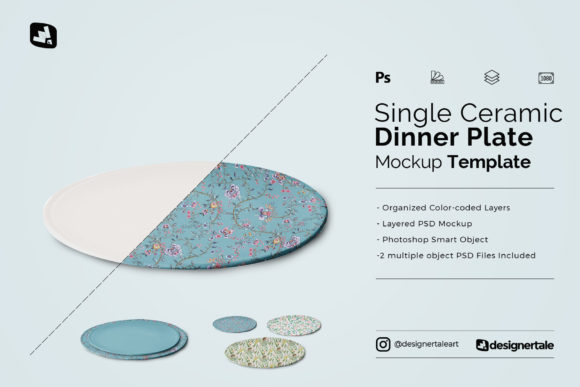
The patterns shown in preview images aren’t included—that’s intentional. It keeps file size lean and gives you full creative control. You bring your own design, whether it’s a raster illustration, vector repeat, or scanned watercolor. Just make sure your artwork aligns with the plate’s center point and scale (the smart object is pre-sized to fit naturally).
This mockup works best when your goal is clarity—not heavy stylization. It’s not meant for surreal composites or dramatic cinematic lighting. Its strength lies in subtlety: soft highlights, gentle rim shadows, and natural ceramic texture that doesn’t compete with your design. If you’re aiming for hyper-stylized editorial shots, you’ll likely need additional retouching—but for 90% of commercial, portfolio, and e-commerce uses, it’s ready out of the box.
Also note: it comes with three separate PSD files—each representing a different angle or setup (e.g., front-facing, slight tilt, overhead). That’s helpful if you’re building a multi-angle product gallery but don’t want to manually rotate or warp a single file. No extra plugins or scripts are required; everything runs natively in Photoshop CC 2019 or later.
Why Resolution and Organization Matter More Than You Think
At 6000 × 4000 pixels and 300dpi, this mockup holds up in print—so if you’re designing for a trade show banner, catalog spread, or investor handout, your plate visuals won’t blur or soften. But more importantly, that resolution gives breathing room during editing. You can zoom in to refine edge blending, adjust highlight intensity on the glaze, or fine-tune how your pattern meets the rim—without losing fidelity.
The color-coded, labeled layers aren’t just tidy—they prevent common errors. For example, the “Plate Base,” “Shadow,” “Highlight,” and “Pattern Insert” layers are grouped logically. If you accidentally edit the wrong layer, it’s obvious. And because the smart object is pre-linked and shortcut-optimized (Ctrl+Shift+I or Cmd+Shift+I to edit), you never have to hunt for nested layers or worry about mismatched dimensions.
One freelance illustrator shared how this saved her from a last-minute client request: “They asked for a ‘warmer’ version of the same plate design, two hours before the deadline. I changed the base color layer, adjusted the ambient light layer slightly, and exported three variants—all in eight minutes. No reshoot. No redraw.”
That kind of responsiveness is why creators keep returning to well-built mockups like the Single Ceramic Dinner Plate Mockup. It doesn’t replace skill—it amplifies it. It doesn’t cut corners—it removes friction. And it doesn’t pretend to be everything at once. It does one thing exceptionally well: helping your ceramic plate designs land with presence, precision, and professionalism.