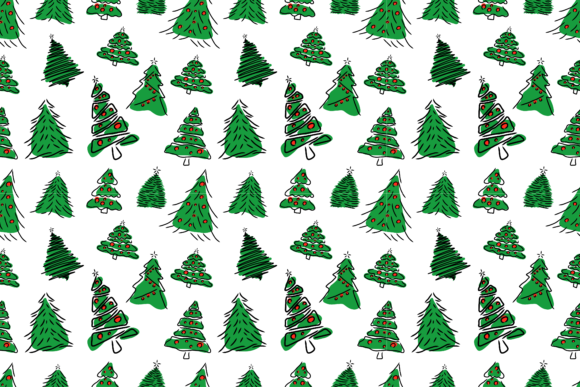
Hand Drawn Pattern Christmas Elements: Versatile, Editable & Ready for Any Holiday Project
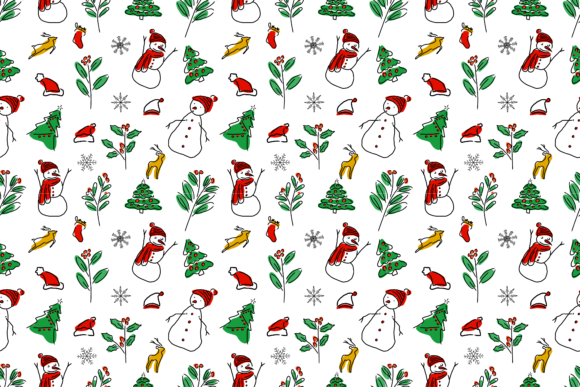
There’s something undeniably warm and inviting about hand-drawn holiday design — a subtle wobble in a snowflake’s line, the gentle irregularity of a holly leaf, or the soft, inked texture of a vintage-style candy cane. That human touch transforms generic seasonal graphics into something personal, nostalgic, and full of character. The Hand Drawn Pattern Christmas Elements collection delivers exactly that: a cohesive set of artisanal, festive motifs — think wreaths, ornaments, stars, pinecones, ribbons, and more — all arranged into seamless, repeatable patterns ideal for cards, packaging, apparel, web banners, and social media visuals.
What You Get — And Why It Matters
This isn’t just another clipart bundle. Each download includes two essential file types:
- 1 x Illustrator CC EPS File — fully editable vector format, scalable to any size without quality loss. Every element is grouped logically, layered thoughtfully, and built with clean anchor points — no embedded rasters or locked objects.
- 1 x High-Resolution PNG File (4376px × 2917px) — crisp, transparent-background raster version, perfect for quick placement in Canva, Photoshop, or PowerPoint when vector editing isn’t an option.
The EPS file is where true flexibility lives. Because it’s vector-based, you’re not stuck with one size or layout. Need a tiny pattern for a gift tag? Scale down. Want to cover an entire wall mural or fabric roll? Scale up — no pixelation, no compromise. And since it’s built in Adobe Illustrator CC, it’s compatible with modern workflows while remaining backward-compatible with older versions (CS6+).
How to Use These Hand Drawn Pattern Christmas Elements Effectively
Start by opening the EPS in Illustrator. You’ll immediately notice how intuitively organized it is: layers labeled “Wreaths,” “Ornaments,” “Background Motifs,” and “Accents” make selective editing fast. Want only the mistletoe cluster? Hide or delete the rest. Prefer a lighter density? Reduce opacity on the background layer or adjust spacing in the pattern tile itself.
Here’s where many designers miss opportunity: don’t treat the pattern as static. The real power lies in remixing. Try ungrouping the tile, rotating individual elements, swapping out a star for a bow, or recoloring using Illustrator’s Recolor Artwork tool. Because these are hand-drawn — not algorithmically generated — each motif has natural variation. That means even small edits retain authenticity, unlike overly uniform digital repeats.
For non-vector users, the high-res PNG offers serious utility. At 4376px × 2917px, it’s large enough to print at 300 DPI on a 14.5" × 9.7" area — ideal for wrapping paper mockups, large-format posters, or Instagram carousels. Just drop it into your layout, apply blending modes (try Multiply over cream-colored backgrounds), or use clipping masks to shape it into banners, frames, or custom buttons.
Real-World Applications Across Industries
Small business owners launching holiday product lines often underestimate how much visual cohesion impacts perceived quality. A candle maker using these Hand Drawn Pattern Christmas Elements on both their Shopify banner *and* their sticker seal sends a quiet signal: care was taken — at every level. Same goes for boutique stationers designing limited-edition greeting cards: the slight imperfection in line weight adds tactility, even on screen.
In education, teachers use the PNG file for printable classroom decorations — think bulletin board borders or themed worksheets. Because the resolution is so high, printed versions hold detail even after photocopying or laminating. Meanwhile, marketing teams building email campaigns benefit from the EPS: they can export lightweight SVGs for web use or generate multiple color variants (navy + gold, sage + cream, charcoal + rust) in minutes — no need to wait for a designer.
Even interior designers lean on this kind of resource. One recent client used the pattern as a base for custom wallpaper — importing the EPS into CAD software, adjusting repeat spacing to match wall dimensions, then exporting to their printer. The result? A living room accent wall that felt bespoke, not stock.
Editing Tips You Won’t Find in the Manual
Before diving into edits, consider your end use:
- For packaging or labels: Keep strokes above 0.25 pt to ensure legibility when printed small. Use the Pathfinder > Unite function to merge overlapping shapes if you plan to foil-stamp or emboss.
- For web or social: Export SVG directly from Illustrator for crisp rendering on any device. To reduce file size, simplify paths via Object > Path > Simplify — but keep fidelity sliders at 70–85% to preserve hand-drawn nuance.
- For embroidery or vinyl cutting: Convert strokes to outlines (Object > Path > Outline Stroke) and check for open paths using Window > Document Info > Objects. Clean joins prevent cutting errors.
Pro tip: Duplicate your original EPS before editing. Save one version as “MASTER” and work only on copies. That way, you can always revert — or generate new variations (e.g., “gold-foil-only,” “monochrome-line,” “watercolor-overlay-ready”) without losing the source integrity.
Why “Just Change the Size You Want” Is More Powerful Than It Sounds
This note — “Just change the size you want” — isn’t filler. It reflects a fundamental advantage of vector-based Hand Drawn Pattern Christmas Elements: resolution independence meets creative autonomy. Unlike raster assets that force trade-offs (small = blurry, large = huge file), vectors respond instantly to your needs. Resize for a favicon? Done. Enlarge for a tradeshow backdrop? No reworking required.
And because the pattern is built as a seamless tile (not a single image stretched across canvas), scaling preserves repetition logic. Illustrator handles tiling math automatically — meaning your snowflakes stay evenly spaced whether the artboard is 100px or 10,000px wide.
Software Recommendations — And What Works Best Where
While the EPS is optimized for Adobe Illustrator CC, it opens cleanly in Affinity Designer, CorelDRAW, and Inkscape (with minor layer flattening). For quick tweaks, Figma users can import the SVG export — though direct EPS support remains limited there.
The PNG works universally: drag it into Canva, Photoshop, Procreate (as a reference layer), or even Microsoft Word for last-minute invites. Just remember — PNGs don’t scale infinitely. If you find yourself zooming past 200% in your editor and seeing soft edges, switch back to the EPS.
If you’re new to vector editing, start simple: change fill colors, hide layers, or copy-paste individual motifs into new compositions. You don’t need mastery to get professional results. In fact, some of the most compelling uses come from minimal intervention — letting the hand-drawn charm speak for itself.
Final Thought: Authenticity Starts With Intentional Tools
Holiday design shouldn’t feel like assembling flat, soulless icons. It should evoke memory, warmth, and intention — the same feeling you get unwrapping a letter sealed with wax and handwritten script. That’s what makes these Hand Drawn Pattern Christmas Elements different. They’re not just assets; they’re starting points for storytelling. Whether you’re crafting a brand’s first holiday campaign or printing 50 personalized cards for family, the combination of editable vectors and high-fidelity raster gives you freedom *and* polish — without sacrificing personality.
So go ahead: resize freely, recolor boldly, layer thoughtfully, and export confidently. Your next holiday project isn’t waiting for perfection — it’s waiting for your voice, amplified by tools that respect both craft and practicality.